


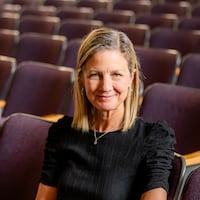
Ayanna Howard will officially become the 12th president of Spelman College on Aug. 1.
Howard has a Ph.D. in electrical engineering and a background in robotics and artificial intelligence. She worked at NASA’s Jet Propulsion Laboratory and held several positions at Georgia Tech, including serving as the associate director of research for the Georgia Tech Institute for Robotics and Intelligent Machines.
In an interview with The Atlanta Journal-Constitution, Howard explained how her background in AI will benefit Spelman. Here are some key takeaways:
She believes tech should be human-centered
Howard, who has undergraduate, master’s and doctoral degrees in engineering, told the AJC that humans should be the focus of technological development. She ran the Human-Automation Systems Lab at Georgia Tech, which focused on “humanized intelligence,” or integrating humanlike thinking into how autonomous systems make decisions.
“Engineers would not consider me a traditional engineer, computer scientists don’t consider me a traditional computer scientist because I’ve always seen it from the people, humanities perspective,” she said. “That’s just who I am.”
Howard founded a company called Zyrobotics, which develops assistive technology for children with disabilities. The idea is to make technology more accessible, so kids can navigate devices more easily. For example, children who don’t have the fine motor skills to swipe on a screen could use an adaptive model, where they could tap the screen instead.

Credit: Natrice Miller for the AJC
Credit: Natrice Miller for the AJC
She doesn’t think there’s enough diversity in AI development
Howard said there isn’t a variety of people deciding how AI products should be used.
“How do you take AI and put it into the community? How do you design it so that it’s fair and equitable? You don’t have people asking the right questions in the rooms,” she said.
She cites campus security as an example. Some cameras use facial recognition technology that has incorrectly identified Black and brown people as criminal suspects.
“So, how do you have someone in the room that says, OK, this is how we think about this, so that we do it responsibly, we do it so that it doesn’t have worse impacts for our … Black and brown communities?” she said.
She wants students to balance tech skills with good stewardship
Howard wants Spelman students to be able to use AI to enhance their chosen discipline, and she recognizes the need for some students to become developers.
“I need mathematicians that say, ‘You know what, I actually know how to create AI tools.’ We need scientists and computer scientists that say, ‘You know what, I can actually program this as well,’” she said. “We need all of those in order to ensure that our students, when they get out into the world, are not just thriving, but they’re also living up to their responsibility in terms of wanting to change the world.”
She also wants Spelman students to change the world by knowing how and when to exercise good judgment in the application of AI.
“You use your understanding of ethics and social responsibility to say, ‘Well, maybe we shouldn’t do this,’ or, ‘Maybe we should do it a different way,’” she said.
About the Author


Keep Reading

The Latest

Featured
